
A RELATIONAL VIEW OF ORGANIZATIONS
Organizations
happen through
relationships.
A common unit for observing an organization: relationships between poles.
People, teams, and organizations interact with different interests, expectations, and contributions. MODR offers a structure for observing the distance between what is expected and what is perceived in those relationships.
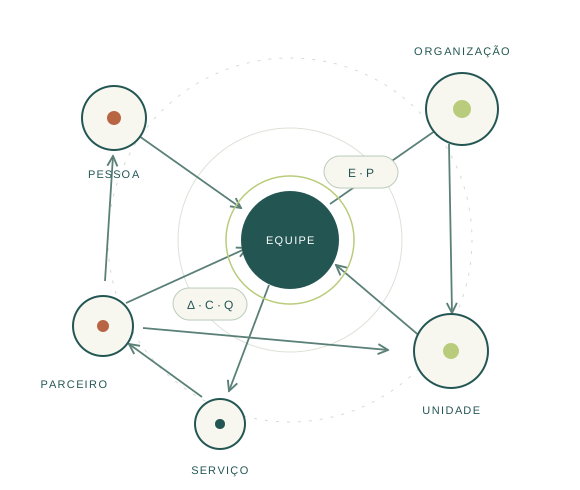
Organizational Modeling
through Relational Distances
Observe relationships, retain contexts,
and ask better questions about the organization.
FROM RELATIONSHIPS TO ORGANIZATIONAL COMPLEXITY
How does MODR expand
our view of an organization?
Over time, relationships among multiple poles may generate tensions that are scattered or concentrated, occasional or recurring, with different consequences for the organization.
This dynamic contributes to relational complexity that outcome and contextual indicators, valuable as they are, may not fully reveal. MODR proposes observing the relationships in which these tensions appear and identifying their configurations while retaining context.
For example, a student expects something of a professor's teaching and evaluates what they perceived in a defined experience.
The same structure can observe Administration → Student or Coordination → Professor. Comparing relationships and examining their distributions helps formulate questions about an organization while retaining each assessment's direction, referent, and components.
Distance expresses the difference between expected and perceived values; its effects and causes require contextual investigation. OTH7600 provides the formulation. This example is illustrative.
CHOOSE YOUR POINT OF ENTRY
Four ways into the program.
Three readings explain MODR for different audiences; the fourth gathers the papers. Choose where to begin.
Understand MODR
An everyday relationship, two judgments, an interactive example, and observations by period or event.
Applied to Organizations
Management questions, tensions across areas, and possibilities for relational diagnosis.
The Research Journey
From Organization Theory to the eight papers, their problems, contributions, and limits.
Published Papers
8 texts with reading prompts, summaries, scope notes, and DOI access through Zenodo.